A multi-generational home is less of a miracle solution and more of a family business project that requires a rigorous legal framework to succeed.
- A notarized cohabitation contract (indivision agreement) is non-negotiable to protect the assets and autonomy of each generation.
- Municipal zoning regulations are the main obstacle; an exhaustive check before any commitment is crucial.
Recommendation: Treat this project with the seriousness of a real estate transaction: formalize all your agreements in writing to preserve family relationships and secure your investment.
Facing an increasingly tight Quebec real estate market, many families are looking for creative solutions to access homeownership while caring for their loved ones. The multi-generational home then appears as an obvious choice: it allows for pooling financial resources, facilitates care for aging parents, and offers support for childcare. It is an idyllic vision where family mutual aid solves the housing crisis.
Yet, this approach, as seductive as it may be, rests on a fragile premise: that trust and family harmony are enough to settle everything. We spontaneously think of cost-sharing and shared moments, but we often forget to plan for disagreements, separations, resales, or simply the need for privacy. But what if the true key to success did not lie in blood ties, but in the clarity of a binding legal framework that protects them? A multi-generational home is not a simple living arrangement; it is a true family business project involving the assets of two, or even three, generations.
This article aims to go beyond the idealized vision to provide you with concrete tools. As a notary, my goal is to guide you through the crucial aspects of the contract, space planning, profitability, and taxation. We will see how to transform this dream into a serene and legally solid reality for everyone.
To navigate the many facets of this project, this article is structured to answer your most pressing questions, from legal foundations to the practical layout of your future home.
Summary: Complete Guide to Multi-generational Homes in Quebec: Legal and Financial Aspects
- Why not signing a cohabitation contract is a major risk for your finances?
- How to establish rules for living together without breaking family ties?
- Single-family home or converted duplex: which option is more profitable over 10 years?
- The zoning error that stops 40% of multi-generational conversion projects
- How to soundproof an existing basement for under $2,000?
- How to lend money to your children for a down payment without legal risks?
- How to turn 50 sq. ft. of balcony into a private oasis without breaking the rules?
- Inheritance or living gift: which tax strategy to prioritize in Canada?
Why not signing a cohabitation contract is a major risk for your finances?
In the enthusiasm of a family project, the idea of putting rules and obligations in writing may seem superfluous, even suspicious. However, in real estate, the adage “good fences make good neighbors” also applies—especially—within the family. Relying on a verbal agreement is the biggest mistake you can make. In the event of a disagreement, separation, death, or a desire to sell, a simple oral agreement has no legal value. Without an official document, you expose yourself to inextricable situations where everyone’s assets are at risk.
The legal solution in Quebec is the indivision agreement (convention d’indivision). This is a notarized contract that establishes the “rules of the game” for your common property. This document does not weaken trust; on the contrary, it cements it by providing clarity and predictability. As highlighted in a legal analysis on undivided co-ownership, without an agreement, owners are exposed to major conflicts regarding the management and administration of the building. The agreement is the only shield that protects each party and guarantees that the initial intentions are respected, even years later.
Your action plan for a solid indivision agreement
- Define ownership shares: Precisely establish the percentage of ownership for each party (e.g., 60% for children, 40% for parents) and exclusive usage rights for respective dwellings and common areas.
- Organize financial management: Clarify who pays for what (taxes, insurance, renovations) and set up a joint bank account for common expenses. Specify joint and several liability for the mortgage.
- Include a right of first refusal: Integrate a clause that obliges a seller to offer their share to the other co-owners as a priority before putting it on the open market.
- Plan exit scenarios: Anticipate procedures in case of death (how is the share valued and bought out?), separation, or forced sale. This is the most delicate but essential point.
- Ensure longevity: The agreement must be notarized and published in the Land Register to be enforceable against third parties. Remember it must be renewed, as its maximum duration is 30 years according to the Civil Code of Quebec.
How to establish rules for living together without breaking family ties?
Once the legal framework is secured, the challenge becomes human: how to cohabit harmoniously? The key is to establish what I call “space sovereignty.” Each family must feel they are “at home” in their unit, with control over their environment and privacy. This goes far beyond simple room allocation; it’s about defining clear lifestyle rules before even moving in. These discussions, while potentially delicate, are an investment in long-term family peace.

This conversation should be approached not as a list of constraints, but as the co-creation of a lifestyle. Think about it: professional co-living platforms seek to match people based on personality and lifestyle. This search for affinity is even more crucial in a family setting. Very concrete subjects must be addressed:
- Noise management: At what times should loud noises be limited (music, vacuuming, footsteps on the floor)?
- Shared spaces: How do we manage the use and maintenance of the yard, laundry room, or entrance?
- Visits: Is it necessary to give notice before going from one unit to another? How are guests and parking managed?
- Family involvement: What are the expectations regarding childcare or assistance for seniors? These must be explicit and not taken for granted.
Single-family home or converted duplex: which option is more profitable over 10 years?
The choice of real estate structure has major financial and practical implications. On one hand, converting an existing single-family home (by finishing a basement or adding an extension) often seems simpler. On the other hand, buying or building a code-compliant duplex offers a clearer separation. In terms of pure profitability, the duplex often has an advantage. Indeed, its nature as “potential income” gives it an added value that can reach 15% compared to an equivalent single-family home in certain Quebec markets.
A legal duplex is also easier to resell because it is not limited to a buyer specifically looking for a multi-generational solution; it can interest any investor. However, converting a single-family home may provide access to renovation grants that are not always available for duplexes. The choice depends on your priorities: maximum flexibility and resale value (duplex) or optimization of initial renovation costs (conversion).
| Criterion | Converted Single-Family Home | Legal Duplex |
|---|---|---|
| Resale Value | Market standard | +15% according to current market |
| Time to Sell | 15 days longer on average | Standard |
| Available Grants | Rénovation Québec, municipal programs | Limited to new constructions |
| Tax Credits (Caregivers) | Up to $5,000 Federal + $2,000 Provincial | Up to $5,000 Federal + $2,000 Provincial |
| Usage Flexibility | Limited to family members | Possible to rent to third parties |
The zoning error that stops 40% of multi-generational conversion projects
You’ve found the perfect house, the renovation plans are ready, and the family agreement is complete. Yet, your project can be stopped dead by a single document: the municipal zoning bylaw. This is the most underestimated and destructive obstacle. Many municipalities in Quebec have very strict rules, and what is allowed in one borough may be formally prohibited in the next. For example, the City of Longueuil allows intergenerational homes in Old Longueuil under strict conditions (ground floor unit, max area 45%), but in the Saint-Hubert borough, they are simply not permitted.
The most common mistake is confusing an “accessory dwelling unit” (often called a “bachelor”) with an “intergenerational dwelling.” The former can often be rented to anyone, while the latter is strictly reserved for a family member with a defined relationship. Standards also differ in terms of square footage, required parking spaces, or setbacks. Ignoring these nuances can force you to undo costly work or make you ineligible for tax credits. Checking with your municipality’s urban planning department is not an option; it is the very first step of your project, even before signing an offer to purchase.
Before you start, make sure to validate the following points:
- The exact definition and conditions of an “intergenerational dwelling” in your municipality.
- Maximum area requirements for the second unit.
- The number of mandatory parking spaces.
- Specific standards for soundproofing and fire safety.
- The requirement that the building owner must reside in one of the two units.
How to soundproof an existing basement for under $2,000?
Privacy, in a multi-generational context, is primarily a matter of acoustics. Hearing footsteps, conversations, or the television from the other unit is the number one source of friction. Good soundproofing is not a luxury, but an essential condition for household peace. Fortunately, it is possible to considerably improve the sound insulation of an existing basement ceiling with a reasonable budget, provided you use the right technique and materials.
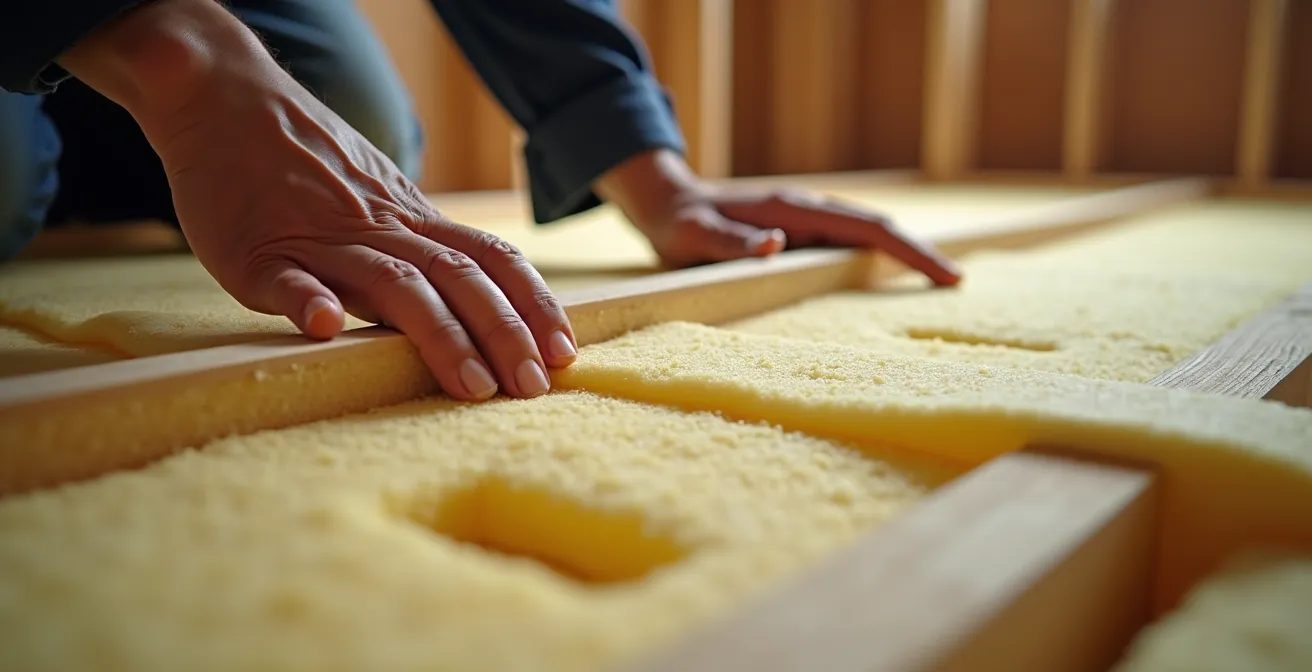
The secret does not lie in a single miracle solution, but in the combination of three principles: decoupling structures, adding mass, and sealing air leaks. For a budget of around $2,000 in materials for an average-sized room, a savvy DIYer can achieve excellent results by following specific steps.
- Fill the cavity: Insert acoustic insulation like rock wool or cellulose between the floor joists. The goal is to completely fill the space to absorb airborne noise.
- Decouple the ceiling: Attach resilient channels (flexible metal profiles) perpendicularly to the joists. These profiles create an air gap and prevent vibrations (impact noise) from being transmitted directly to the new ceiling.
- Add mass: Screw a double layer of 5/8″ Type X (fire-rated) gypsum panels to the metal profiles. Ensure you stagger the joints between the first and second layers for maximum efficiency.
- Seal airtight: Apply a flexible acoustic sealant to all joints, around the perimeter of the ceiling, and around electrical boxes or light fixtures. The smallest gap can ruin soundproofing efforts.
How to lend money to your children for a down payment without legal risks?
Financial help from parents is often the necessary boost to finalize a down payment. In Canada, this phenomenon is far from anecdotal: recent data shows that about one-third of first-time buyers receive family help, with a significant average amount. However, how this help is formalized is vital, both for mortgage approval and for protecting your money.
Financial institutions require a clear distinction: is it a gift or a loan? A gift is a sum of money given without expectation of repayment. A loan, even interest-free, is a debt that must be declared. For the mortgage, banks generally require a signed “gift letter” where parents explicitly state that the money does not have to be repaid. This letter seems simple, but it has a major consequence that few parents anticipate: in the event of their child’s separation, if the house is sold, the ex-spouse is entitled to half of the net value, which includes your gift. The money has legally left your assets and entered those of the couple.
To protect yourself, if your intention is to recover the amount one day, you must draft a notarized promissory note or a loan agreement. This document can even be secured by a second mortgage on the property. This clarifies the situation for everyone and protects your capital in case of resale or separation. The choice between a gift and a loan is not trivial; it has deep legal and family implications that deserve transparent discussion.
How to turn 50 sq. ft. of balcony into a private oasis without breaking the rules?
In a multi-generational home where proximity is constant, having a small private outdoor space is not a luxury—it’s a psychological necessity. A balcony, even a modest one, can become this haven of peace, a personal “decompression zone.” The challenge, especially in duplexes or co-ownerships, is to create privacy without violating regulations that often prohibit drilling into walls or permanent structures.
Fortunately, ingenious and non-invasive solutions exist to protect yourself from prying eyes and create a cozy atmosphere. The idea is to rely on freestanding, modular, and reversible elements. Rather than thinking in terms of construction, you must think in terms of layout and strategic decoration. Here are some concrete ways to maximize the privacy and functionality of your small outdoor space:
- Freestanding screens: Use weighted outdoor privacy screens or panels on feet that require no attachment to the building.
- Strategic vegetation: Install tall, narrow planters along the railing and plant tall grasses or climbing plants on a trellis integrated into the pot.
- Tension shades and sails: Opt for tension systems with pressure poles that wedge between the floor and the ceiling of the balcony above, allowing a cloth to be stretched without drilling.
- Smart furniture: Choose storage benches that serve as both storage and seating, or folding tables that attach to the railing to free up floor space.
- Ambient lighting: Prioritize solar lighting (string lights, path lights) that requires no electrical connection and adds a warm touch in the evening.
Key Takeaways
- A notarized indivision agreement is the only document that protects your investment and your relationships in case of the unexpected.
- Zoning regulations are specific to each municipality (and even borough) and must be the very first verification step before any purchase.
- Beyond finances, preserving the “space sovereignty” of each family (privacy, noise, access) is essential to the long-term success of the project.
Inheritance or living gift: which tax strategy to prioritize in Canada?
The question of asset transfer is at the heart of the multi-generational project. Should you wait for the estate or help your children during your lifetime? From a fiscal and practical standpoint in Canada, a living gift, when well-structured, offers considerable advantages. Helping with a down payment, for example, can allow the child to reach the 20% threshold and thus avoid paying CMHC mortgage insurance, a saving that can represent tens of thousands of dollars.
Furthermore, when the real estate transaction takes place between direct-line family members (parents to children), buyers are exempt from transfer duties, the famous “Welcome Tax” in Quebec. This is another substantial saving. Finally, housing a parent can provide eligibility for significant tax credits. In total, caregiver tax credits can reach up to $7,000 by combining federal and provincial programs.
These advantages make living gifts very attractive, but they must be planned with care. The donor must ensure they retain enough assets to support their own future needs. The gift must not put them in a precarious situation. This is why financial and estate planning with a notary and a financial planner is essential to find the right balance between present generosity and future security.
To transform this complex project into a family and heritage success, the next step is to consult a notary. They will be able to translate your intentions into a solid legal framework that will protect all generations involved.