Contrary to popular belief, choosing between piano and guitar after 40 is not a popularity contest, but a strategic decision for your brain health.
- The ideal instrument is the one that offers the best haptic feedback (touch) to build solid procedural memory.
- Consistency in practice (15-30 min/day) is biologically more effective for brain plasticity than one long weekly session.
Recommendation: Approach musical learning not as an art to be mastered, but as a personalized cognitive fitness program, where every note played is a workout for your brain.
You hit forty, and with it comes that powerful urge to take on a new challenge, to cultivate your inner garden, and to not let your mind go dormant. You are thinking about music, a youthful aspiration or a new curiosity. But then the classic dilemma arises: the prestige of the piano or the conviviality of the guitar? You have probably already heard the usual arguments: the piano is more “complete,” the guitar is “easier to transport.” These debates, while legitimate, miss the essential point for an adult looking to stimulate their cognitive faculties.
What if the real question wasn’t “piano or guitar?”, but rather “what is the best training program for my brain?”. After 40, learning an instrument is less about a quest for virtuosity and more about a powerful cognitive fitness exercise. The stakes are no longer just about producing pretty melodies, but about forging new neural connections, maintaining memory, and strengthening brain plasticity. Music becomes a tool, a form of active and deeply rewarding mental hygiene.
This article is not a simple comparison. It is a guide designed for you, the adult who wants to invest in their brain capital. We will break down together, not which instrument is “better,” but how each instrument, each method, and each practice routine specifically impacts your brain. You will discover why the touch of a keyboard, the position of a chord, or the regularity of your sessions are the true keys to transforming this hobby into a lasting ally for your memory and mental agility.
To navigate through the essential aspects of this approach, this guide is structured to answer your most concrete questions. You will find practical advice and insights based on neuroscience to make an informed choice, not only for your ears but especially for your brain.
Summary: Piano or Guitar, the Cognitive Match After 40
- Why reading sheet music is like learning a new language for your brain?
- How to soundproof your music room for less than $100?
- Acoustic piano or digital keyboard: is weighted action essential for beginners?
- The wrist position error that causes tendonitis in beginner guitarists
- How long to play per day: why 15 minutes are better than 2 hours on Sunday?
- When to file a noise complaint: effective procedure at the administrative tribunal
- Micro-certification or intensive DEC: which format appeals most to recruiters in 2024?
- How to do a “digital detox” on the weekend without FOMO?
Why reading sheet music is like learning a new language for your brain?
Approaching a score for the first time can seem as intimidating as deciphering hieroglyphics. Yet, this activity is one of the most complete exercises you can offer your mature brain. Reading music is not simple symbol recognition; it is a real-time decoding process that simultaneously engages several brain areas. You must translate visual information (the note on the staff) into a precise motor action (pressing a key or plucking a string) while interpreting its duration, intensity, and relationship with other notes. It is a true dialogue between your eyes, your brain, and your hands.
This mental gymnastics creates what neuroscientists call increased brain plasticity. By forcing your brain to establish new communication pathways to process this musical “language,” you literally strengthen its architecture. A study from the University of Geneva confirmed that among retirees, piano practice led to a 6% increase in working memory performance, that essential faculty for manipulating short-term information.
Whether you choose piano or guitar, reading a score (or tablature, in the case of the guitar) intensely requires coordination and synchronization. As Piano Académie points out, this exercise promotes exceptional interhemispheric communication.
Piano practice engages both the left and right hemispheres of the brain, promoting increased interhemispheric communication through the corpus callosum.
– Piano Académie, Cognitive and Psychological Benefits of Learning the Piano
By learning this new language, you are not just learning to play pieces. You are building a denser and more resilient neural network, an invaluable asset for preserving your mental agility over the years. Every decoded score is a victory against cognitive aging.
How to soundproof your music room for less than $100?
One of the greatest sources of anxiety for a beginner adult musician, especially in an apartment or condo in Canada, is the fear of disturbing neighbors. This fear can become a major obstacle to regular and relaxed practice. Fortunately, it is not necessary to build a professional studio to find peace of mind. With a controlled budget, it is entirely possible to significantly improve the acoustics of your room and limit the spread of sound.
The goal is not total soundproofing, which is extremely expensive, but rather acoustic treatment and the mitigation of sound leaks. This involves absorbing sound waves inside the room to prevent them from reverberating and blocking the paths through which sound escapes. Simple and affordable solutions, available at big-box stores like Home Depot or RONA, can make a huge difference.
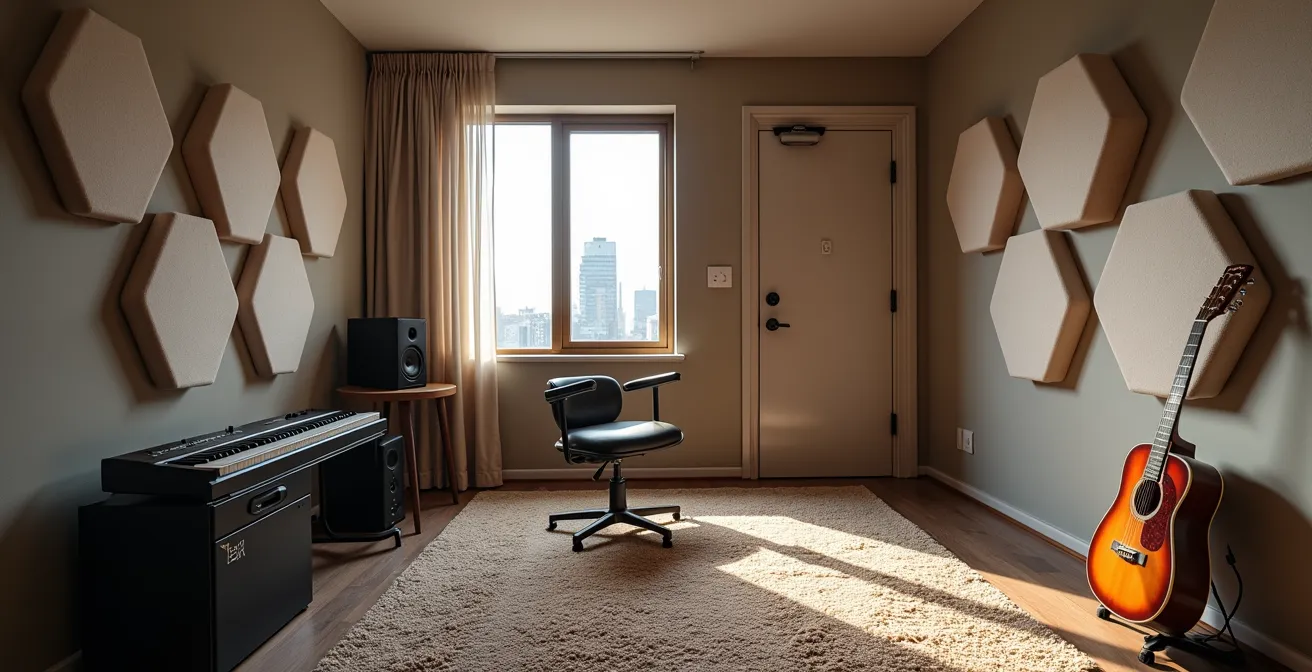
The image above illustrates how discreet elements can transform a living corner into a viable practice space. The challenge is to combine several techniques for a cumulative effect. Here are some economical and effective solutions to put in place to maintain good neighborly relations and allow you to play with peace of mind:
- Install self-adhesive hexagonal acoustic panels on the walls facing your speakers or instrument to absorb first reflections.
- Add door draft stoppers and window weatherstripping, as these are the most common sound leak points.
- Place thick rugs and bookshelves filled with books against shared walls; these masses help dampen vibrations.
- For a more robust solution, SONOpan panels, made in Canada from recycled wood, offer an excellent acoustic barrier and can be placed behind a bookshelf or heavy furniture.
- Finally, never underestimate the power of a good quality pair of headphones, especially for a digital keyboard or electric guitar. This is the most economical and effective solution for practicing at any hour.
Acoustic piano or digital keyboard: is weighted action essential for beginners?
The question of “touch” is central, especially after age 40. Beyond the sound, the physical sensation of the instrument is a pillar of learning. For the brain, the creation of procedural memory (muscular “know-how”) depends heavily on the quality of sensory feedback. A “weighted” or hammer-action touch mimics the mechanical resistance of a real piano. Every nuance of pressure from your fingers is translated into a nuance of sound volume. This cause-and-effect relationship is crucial: it teaches your brain to gauge strength and develops fine proprioception.
For an adult, starting directly with a weighted touch is an investment in the quality of cognitive learning. It builds solid motor foundations that will be transferable to any piano. However, it is also important to listen to your body. If you suffer from arthritis or joint pain, a keyboard with too much resistance could be discouraging. Semi-weighted touch then represents an excellent compromise, offering sufficient resistance for muscle work without generating excessive fatigue. Non-weighted keyboards, similar to entry-level synthesizers, should be avoided: their lack of haptic feedback does not allow for building a nuanced technique and can even anchor bad habits.
The following table summarizes the options to help you make an informed choice, taking into account the realities of the Canadian market.
| Keyboard Type | Advantages for 40+ | Disadvantages | Average Price Canada |
|---|---|---|---|
| Weighted (Hammer Action) | Develops proprioception and muscle memory | Can be tiring if arthritis is present | 800-1500 CAD |
| Semi-weighted | Good compromise between comfort/feedback | Fewer dynamic nuances | 400-800 CAD |
| Non-weighted | Very light, low fatigue | Little sensory feedback | 200-400 CAD |
Your life experience is an asset. Do not see age as a hindrance, but as a richness. Your emotional maturity gives you a depth of interpretation that a young prodigy cannot yet possess. This is what this inspiring testimony reminds us.
As an adult, you have inevitably lived through significant experiences that nourish your musical interpretation. Composers wrote their masterpieces in adulthood, not in adolescence – your emotional experience is a major asset for musical expression.
– Futur-Pianiste.com
The wrist position error that causes tendonitis in beginner guitarists
Whether on the piano or the guitar, posture is the silent grammar of music. Poor posture is not just inelegant; it is the fast track to frustration, pain, and quitting. The most common error in beginner guitarists is “breaking” the wrist of the hand forming the chords, creating an acute angle that compresses the tendons. On the piano, it is a wrist that is too low or collapsed that causes the same type of stress. This tension, repeated day after day, leads almost inevitably to tendonitis.
From a neuro-cognitive point of view, poor posture sabotages learning. The brain, busy managing pain or discomfort, allocates fewer resources to the main task: encoding the procedural memory of the piece. You are fighting against your own body instead of working with it. The key is to automate good posture from the start, so that execution becomes fluid and unconscious. This is a fundamental principle of motor learning.
Writer and cognitive scientist Gary Marcus, in his book “Guitar Zero,” brilliantly describes this process. He explains how repetition transforms conscious and laborious knowledge into automatic skill.
The brain makes a transition from explicit knowledge to implicit knowledge that can be executed with speed. Repeat again: that is the key to procedural acquisition.
– Gary Marcus, Guitar Zero: the new musician and the science of learning
The problem is that if you repeat poor posture, you anchor toxic implicit knowledge. Prevention is therefore essential. Before each session, take five minutes to prepare your body. This warm-up is not a waste of time; it is an investment to ensure that every minute of practice will be effective and pain-free.
Your preventive action plan: 5-minute warm-up routine
- Gentle stretches: Extend your arms in front of you, palms up then down, and gently pull your fingers toward you with the other hand for 30 seconds for each wrist.
- Wrist rotations: Fists closed without clenching, perform 10 slow and controlled rotations in each direction to lubricate the joint.
- Finger flexions/extensions: Open and close your hands slowly, spreading your fingers to the maximum and then folding them, 10 times in a row, to activate circulation.
- Forearm massage: With the thumb of the opposite hand, firmly massage the forearm muscles from the elbow to the wrist to release tension.
- Slow chromatic scales: On your instrument, play a chromatic scale (note by note) very slowly, focusing solely on the relaxation of the hand, wrist, and shoulder.
How long to play per day: why 15 minutes are better than 2 hours on Sunday?
In our performance culture, we tend to believe that “longer is better.” For musical learning after 40, this is a fundamental error. The brain is not a muscle that can be exhausted for hours in the hope of fast results. It is an organ that learns through cycles of practice and rest. The real work of memorization, synaptic consolidation, does not happen while you are playing, but afterward, while you are sleeping or resting.
Imagine that each practice session sows seeds in your brain. A short daily practice of 15 to 30 minutes sows a few seeds every day, which your brain has time to water and sprout overnight. A long session of “binge-practicing” on the weekend is like throwing a whole bag of seeds in the same spot: most will not have the resources to take root and will be lost. Consistency is biologically superior to intensity.
This approach is supported by research. A study published in Frontiers in Aging Neuroscience showed that regular practice of an instrument has measurable and protective effects on brain structure. The study revealed that just 30 minutes of daily practice for 6 months stabilizes the white matter of the fornix, a key area for memory.
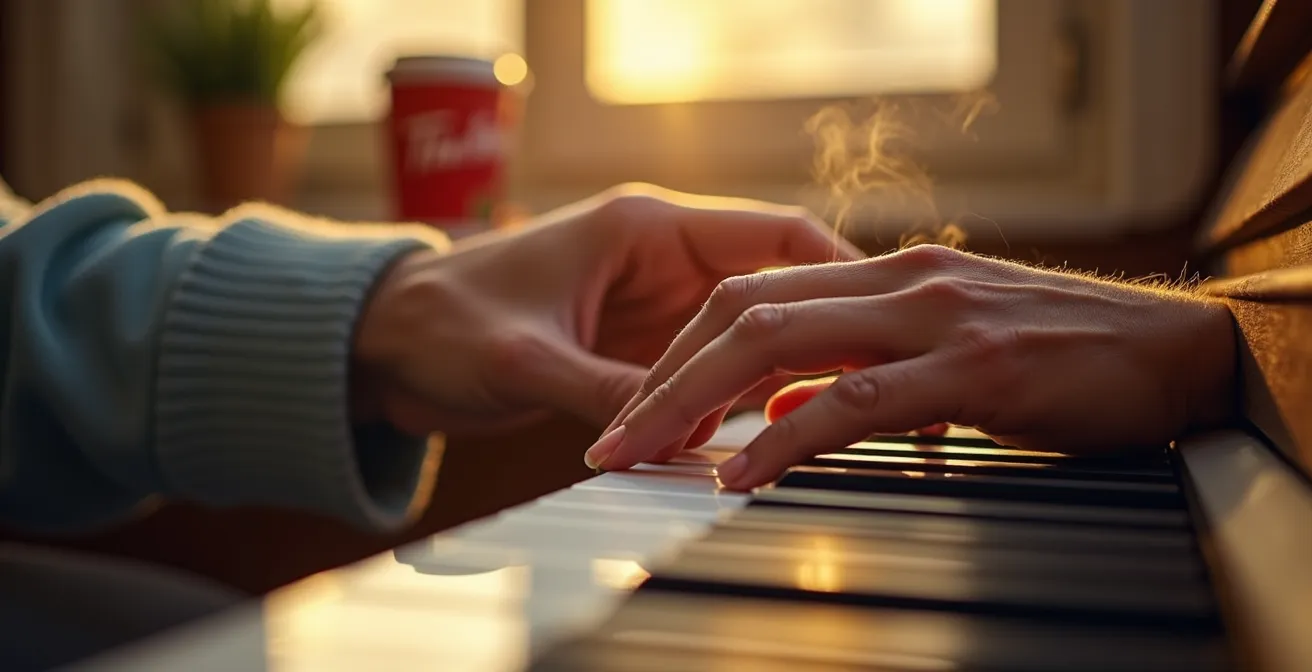
The trick is to integrate music into your routine, like your morning coffee. Associating practice with an existing ritual makes it easier to maintain. It is not a chore, but a privileged moment of connection with yourself. These 15 daily minutes, where you are fully focused, are infinitely more beneficial for your brain and your motivation than a two-hour struggle that leaves you exhausted and frustrated.
When to file a noise complaint: effective procedure at the administrative tribunal
Addressing the issue of legal action may seem extreme, but knowing your rights and duties is a reassuring step that, paradoxically, allows for better management of neighborly relations. The goal is not to enter into conflict, but to practice with full knowledge of the facts, within the respect of the Canadian regulatory framework. The vast majority of conflicts can be resolved through simple and respectful communication.
In Canada, noise bylaws are generally municipal. Cities like Montreal, Toronto, or Vancouver have clear frameworks: instrumental practice is typically authorized during extended hours, often from 7 AM to 10 PM or 11 PM. Informing your neighbors of your new hobby and your planned practice hours is the first and most effective step to defusing any potential conflict. Explain your approach, show that you are taking measures to limit nuisances (as seen previously), and find common ground.
Complaints and recourse to the Tribunal administratif du logement (in Quebec, for example) should only be considered as a very last resort, after having exhausted all options for dialogue and mediation. The tribunal intervenes in cases of “excessive and unreasonable nuisance,” a subjective notion. It will seek to know if you have acted in good faith to minimize the noise. Having invested in acoustic panels, using headphones, or respecting reasonable hours are strong arguments in your favor.
The goal is to create an environment where your musical practice is perceived not as a nuisance, but as a normal life activity, exercised in mutual respect. By being proactive and transparent, you transform a potentially hostile neighbor into an understanding ally, or even your first fan!
Micro-certification or intensive DEC: which format appeals most to recruiters in 2024?
Although the title evokes a professional context, the fundamental question for the adult learner is: “should I learn alone with applications, or follow a structured path with a teacher?”. The answer depends on your goals, but for optimal cognitive learning after 40, the balance clearly tips one way. Apps like Yousician or Simply Piano are attractive for their flexibility and low cost. They are excellent for getting started, becoming familiar with the instrument, and maintaining motivation through gamification.
However, their greatest weakness is the lack of postural feedback. An application will never see that your wrist is broken, that your back is hunched, or that your shoulder is tense. It validates the note played, not the way it is produced. Yet, as we have seen, anchoring poor posture is the best way to slow progress and get injured. This is where the value of a structured format, whether a private teacher, group classes at a cégep, or a community center, becomes evident.
As an expert from Curtis Music points out, human feedback is irreplaceable for an adult. A teacher does not just correct your musical errors; they sculpt your posture, optimize your movements, and adapt the method to your morphology and potential physical limitations. It is a personal coach for your cognitive fitness.
The following table compares these approaches from the angle of the specific needs of an adult learner in Canada.
| Method | Advantages | Disadvantages | Monthly Cost (CAD) |
|---|---|---|---|
| Apps (Yousician, Simply Piano) | Schedule flexibility, personalized progression | No postural correction, risk of bad habits | 15-30 CAD |
| Private Teacher | Personalized feedback, injury prevention | Fixed hours, higher cost | 120-200 CAD |
| Group Classes (cégep/university) | Structure, social motivation, credibility | Less individual follow-up | 50-100 CAD |
A hybrid approach is often ideal: using applications for daily reading and rhythm work, and seeing a teacher once or twice a month to validate posture, correct flaws, and receive personalized advice. It is the best of both worlds.
Key Takeaways
- The choice of instrument is secondary to the brain-targeted learning method: the “how” matters more than the “what.”
- Consistency (15-30 min/day) is biologically more effective than intensity for consolidating procedural memory and brain plasticity.
- External feedback (teacher) or internal feedback (weighted touch) is crucial for building correct motor memory and preventing injuries.
How to do a “digital detox” on the weekend without FOMO?
In a world of hyperconnectivity, “Fear Of Missing Out” (FOMO) – the fear of missing something – is a source of constant anxiety. Putting down your phone is a challenge. Musical practice, by its very nature, is a powerful antidote to this modern-day ailment. You cannot play the guitar correctly while scrolling through Instagram, nor decipher a score while answering emails. Music requires total and exclusive attention. It is a mindfulness activity par excellence.
While you are practicing, your brain is entirely mobilized by hand coordination, reading, listening, and rhythm. There is no more room for notifications or parasitic thoughts. This state of “flow” is not only extremely beneficial for concentration, but it also operates a powerful psychological substitution. Music combats FOMO by replacing it with JOMO: the “Joy Of Missing Out”. The tangible satisfaction of nailing a difficult chord or playing a fluid passage generates an internal reward much deeper and more lasting than the ephemeral like on a post.
Canada offers great opportunities to experience this musical disconnection socially. In the summer, the “Tam-tams du Mont-Royal” in Montreal bring together hundreds of amateur musicians for improvised jams. In the Maritimes, the culture of traditional music sessions in pubs is an institution. Organizations like CAMMAC even offer music camps for adults, providing complete immersion away from screens. These experiences anchor music in reality, sharing, and community, far from digital validation.
Transforming your musical practice into a disconnection ritual is a winning strategy. It is a moment you grant yourself, a space where the only performance that matters is your own progress. By focusing on creating something real and personal, the anxiety of the virtual world naturally fades. Music reminds you of the pleasure of simply being there, present to yourself.
You now have all the keys in hand, not to choose between piano and guitar, but to build your own cognitive fitness program. The instrument is only the starting point. The real transformation lies in consistency, awareness of movement, and the rediscovered pleasure of learning. Don’t wait for the perfect moment: choose your tool, define your 15-minute routine, and start today to invest in the health and youth of your brain.
Frequently asked questions about learning piano or guitar after 40
What are the acceptable hours for playing an instrument in Canada?
Bylaws vary by municipality, but the generally tolerated time range is between 7 AM and 10 PM on weekdays, and 9 AM to 10 PM on weekends. Open communication with your neighbors remains the best approach.
Are there alternatives to practicing at home?
Yes, absolutely. Many Canadian cities offer rehearsal studios to rent by the hour, such as the Rehearsal Factory chain in Ontario. Municipal community centers and some music schools also offer accessible practice rooms.
How to avoid neighbor conflicts?
The key is proactivity. Inform your neighbors of your practice hours, invest in simple soundproofing solutions (rugs, door draft stoppers), and prioritize the use of headphones for digital or electric instruments. Dialogue prevents 99% of problems.