Summary:
- In Canada, an approved personal flotation device (PFD) or life jacket is mandatory on board any stand-up paddleboard (SUP).
- Consuming alcohol on your board is a criminal offense, treated with the same severity as impaired driving in a car.
- In cold water (below 15°C), wearing a wetsuit is as crucial as a PFD to prevent cold water shock.
- Your PFD must be accompanied by a sound-signaling device (pealess whistle) and, if you are not wearing the PFD, a floating throw line of at least 15 meters.
The sun is shining, the lake is calm. It’s the perfect day to take out your stand-up paddleboard (SUP) and enjoy Quebec’s magnificent bodies of water. But before you head out, one question lingers: which vest should I have? Is it a PFD? Is a simple flotation vest enough? Confusion is common, and the consequences of a mistake can go far beyond a simple fine. Many believe that simply having a “vest” on board is enough to be in compliance, without worrying about its type, condition, or other required equipment.
This approach is not only risky but ignores the profound logic behind Transport Canada’s regulations. The goal is not simply to impose a constraint, but to provide you with a complete safety system. The real question is not “which vest will avoid a fine?” but rather “how does my equipment guarantee my survival in the event of the unexpected?”. The $200 fine is just the tip of the iceberg of the risks involved.
This article takes the perspective of a boating instructor: we will break down the regulations not as a list of rules, but as a set of logical safety principles. You will understand why a beer on your board is a criminal offense, how a simple whistle can save your life, and why your choice of equipment is actually a survival strategy choice, far beyond simple legal compliance.
To navigate with full knowledge of the facts, this article details the crucial aspects of paddleboard safety, from alcohol regulations to the reflexes to adopt when facing the elements. Explore the summary to directly access the information that is most useful to you.
Summary: Life Jacket or PFD, the Complete Guide for Paddleboarding
- Why is a beer on a boat treated exactly like a DUI under criminal law?
- How to cross paths with a sailboat or a Sea-Doo without causing an accident?
- Inflatable or rigid kayak: which is more stable for a beginner on Lake Memphremagog?
- The mistake of not wearing a wetsuit in June when the water is still 12 degrees
- When to get out of the water: wind signs that signal a sudden storm on the lake
- The mistake of leaving without offline maps that turns a trip into a rescue operation
- Plank on hands or elbows: which one engages the deep core muscles better?
- Wild Camping or Glamping: which experience to choose for a first contact with nature?
Why is a beer on a boat treated exactly like a DUI under criminal law?
The idea of a cold beer while floating on the water sounds idyllic, but it can turn a dream day into a legal nightmare. In Canada, the law makes no distinction between driving a car and operating a vessel, including a paddleboard, under the influence of alcohol. The reason is simple: alcohol impairs judgment, slows reflexes, and decreases coordination—essential faculties for reacting to a change in weather, a wave, or another vessel. Alcohol is a factor in nearly 30% of drownings in Quebec, demonstrating its danger on the water.
What surprises boaters most is that the offense is not limited to “driving.” The concept of “care and control,” derived from section 320.14 of the Criminal Code, applies. This means that even if you are at anchor or simply drifting, the mere fact of having access to your vessel while impaired can lead to a criminal charge. The consequences are identical to those for drunk driving:
- First offense: a minimum fine of $1,000 and a criminal record.
- Second offense: a minimum prison sentence of 30 days.
- Third offense: a minimum prison sentence of 120 days.
These penalties, detailed in the regulations on operating a vessel while impaired, apply to all “conveyances,” with no exception for human-powered craft. The rule is therefore zero criminal tolerance. The only safe and legal option is to completely separate alcohol consumption from any nautical activity.
How to cross paths with a sailboat or a Sea-Doo without causing an accident?
As a user of a human-powered craft like a paddleboard, you are considered one of the most vulnerable actors on the water. Right-of-way rules are designed to protect you. The golden rule is predictability. When facing a motorized vessel (like a Sea-Doo) or even a sailboat (which is less maneuverable), your duty is to maintain your course and speed. It is the responsibility of the other vessel, being more powerful and maneuverable, to avoid you.
However, never assume that the other operator has seen you. Paddleboards are low on the water and can easily disappear in sun glare or the blind spot of a larger boat. This is where your safety equipment becomes an active communication tool. According to Transport Canada, it is mandatory to have a sound-signaling device. A simple pealess whistle, attached to your PFD, is your best ally. If you think a boat hasn’t seen you or is heading dangerously toward you, use it to signal your presence clearly and audibly.
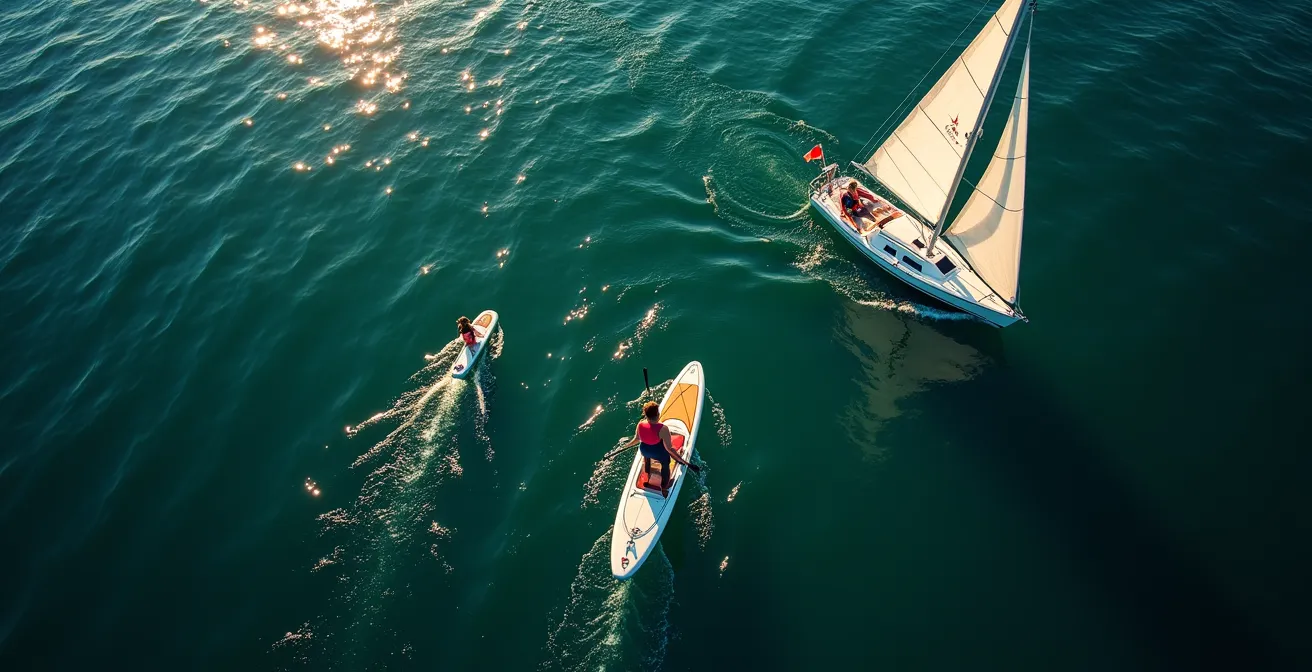
As illustrated in this view, maintaining a lateral safety distance is just as important. Avoid cutting close to a boat’s path, even if you have the right of way. Give it ample space to maneuver. Anticipate its movements: a water-ski boat is towing someone, a fishing boat moves slowly. Adjust your trajectory to avoid any ambiguous situations and ensure you always remain visible.
Inflatable or rigid kayak: which is more stable for a beginner on Lake Memphremagog?
The choice between an inflatable kayak and a rigid kayak for a beginner navigating a large body of water like Lake Memphremagog is a matter of compromise between stability and performance against the elements. Modern inflatable kayaks offer excellent primary stability (the feeling of stability on calm water) due to their width. However, this same width and their light weight make them very vulnerable to windage, a critical factor on a lake known for sudden weather changes.
A rigid kayak, while potentially less stable at a standstill, offers much better performance against wind and waves. It “cuts” through the water instead of floating on top of it, making it easier to steer and safer when conditions deteriorate. For a beginner, the ease of re-boarding after a capsize is also an essential criterion, an exercise that is often simpler with a rigid kayak using the right techniques.
Regardless of your choice, wearing a Transport Canada-approved PFD is non-negotiable. The false sense of security of an inflatable kayak should never lead to leaving the PFD aside. The following table summarizes the key points for making an informed choice.
| Criterion | Inflatable Kayak | Rigid Kayak |
|---|---|---|
| Primary Stability | Excellent (significant width) | Good to moderate |
| Wind Performance | Low (high windage) | Excellent |
| Ease of Re-entry after Capsize | More difficult | Easier with technique |
| PFD Requirement | Mandatory – false security | Mandatory – essential |
| Suitability for Lake Memphremagog | Risky (sudden winds) | Recommended |
This comparison, based on boating safety principles, shows that for a large lake like Memphremagog, a rigid kayak is generally the more prudent choice for a beginner, provided they learn basic recovery techniques. Approved PFDs, as highlighted in an equipment analysis by MEC Canada, are designed to keep you afloat and give you the time needed to get back on board, regardless of the type of vessel.
The mistake of not wearing a wetsuit in June when the water is still 12 degrees
In June, the ambient air can be warm and sunny, inviting swimsuits. This is a potentially fatal mistake. On large Quebec bodies of water, the water temperature remains freezing at the start of summer. For example, Great Lakes temperature data often shows values that struggle to exceed 12 to 15°C in June. Falling into water at this temperature causes cold water shock, a much more immediate danger than hypothermia itself.
Upon immersion, the body undergoes an involuntary “gasp reflex.” You breathe in sharply and uncontrollably, which can lead to near-instant drowning if your head is underwater. This is a physiological reaction that willpower cannot counter. According to a Transport Canada publication on cold water safety, wearing your PFD is absolutely essential in this scenario. It keeps you at the surface and keeps your head out of the water during this critical phase, giving you a chance to regain control of your breathing.
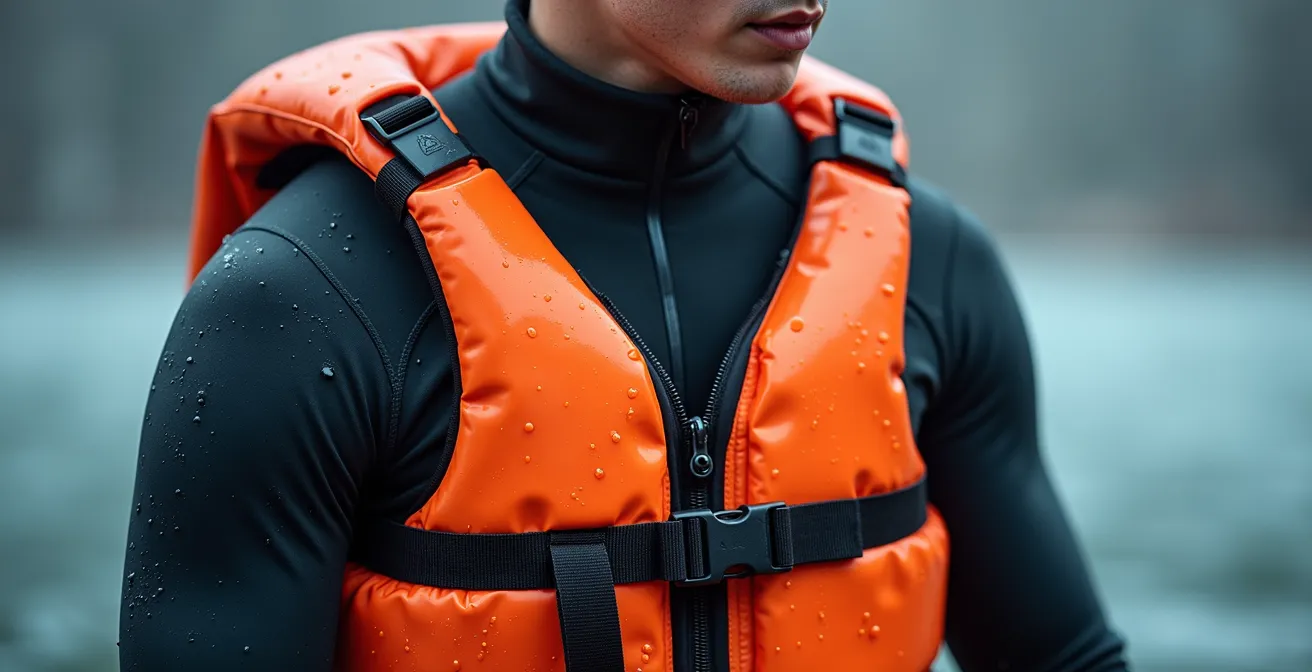
To protect against the cold, a wetsuit is indispensable. It doesn’t keep you dry, but traps a thin layer of water between your skin and the neoprene, which your body warms up. This thermal insulation drastically slows down body heat loss and mitigates the initial shock of immersion. The rule is simple: if the water temperature is below 15°C, wearing both a wetsuit and a PFD is not an option—it is a standard safety procedure.
When to get out of the water: wind signs that signal a sudden storm on the lake
Weather on a large lake can change in minutes, turning a peaceful ride into a struggle for survival. As a paddleboarder, your worst enemy is the wind. It is therefore crucial to know how to recognize the warning signs of deterioration and to have a clear action plan. The most visible sign is the appearance of “whitecaps”, those crests of white foam that form at the top of waves. If they appear offshore and are moving closer, it’s the signal to immediately return to shore.
Another indicator is wind direction. An offshore wind (blowing from the shore toward the open water) is particularly dangerous. It can push you far from the edge without you realizing it, making the return extremely difficult, if not impossible. A paddler safety study indicates that when winds reach 30 km/h or more, you must seriously question your ability to paddle against them to return. If you have any doubt, don’t go. If you are already on the water and the wind picks up, it’s time to activate your emergency plan.
This plan must be a reflex. It cannot be improvised and aims to minimize your wind resistance and maximize your safety:
- Put on your PFD immediately if it isn’t already on you.
- Lower your center of gravity: get on your knees, or even sit on the board. You will offer less resistance to the wind and be much more stable.
- Paddle toward the nearest shore. It might not be your starting point, but safety takes priority over convenience.
- If you are no longer making progress, do not exhaust yourself. Stay on your board, which is an excellent float, and use your whistle to signal distress.
Anticipating and reacting to the first signs of wind is key to preventing an uncomfortable situation from becoming a dangerous one.
The mistake of leaving without offline maps that turns a trip into a rescue operation
In the excitement of departure, we focus on the board, the paddle, and the PFD, forgetting a detail that can make all the difference: navigation. Relying on cell coverage on a large lake or along a winding river is a serious mistake. Dead zones are numerous, and finding yourself disoriented without a way to find your bearings quickly turns a beautiful ride into a stressful situation, or even a rescue operation. An offline map on your phone, placed in a waterproof case, is a piece of equipment as essential as your PFD.
The PFD, beyond its flotation function, should be considered your survival equipment “hub.” Its pockets are not there for decoration. They should contain the bare essentials to face the unexpected. As the MEC mandatory gear guide reminds us, every vessel must have a sound-signaling device, and the PFD is the ideal place to attach your whistle. It thus becomes your personal gear carrier, ensuring that the essentials stay on you, even if you are separated from your board.
To ensure your legal compliance and safety, an audit of your equipment before each outing is indispensable. Here are the points to check to build your minimalist survival kit.
Your Legal and Survival Equipment Checklist
- PFD: Check that it is approved in Canada (visible tag), the correct size, and free of tears. It must be on board at all times.
- Sound Device: Ensure you have a pealess whistle, attached directly to your PFD for immediate access.
- Buoyant Heaving Line: If you are not wearing your PFD, a floating rope of at least 15 meters is mandatory on board.
- Navigation: Is your phone charged, in a waterproof case, with a mapping app and the map of your area downloaded for offline access?
- Night Visibility: Even if you don’t plan to be out at night, carry a waterproof flashlight. A trip can last longer than expected.
This kit is not a suggestion; it forms the basis of your responsibility as a boater. Leaving without one of these items is like taking to the road without headlights or brakes.
Plank on hands or elbows: which one engages the deep core muscles better?
This question, typical of the fitness world, may seem out of place here. Yet, it offers an excellent analogy for understanding two approaches to paddleboard safety: the passive posture and the active posture. In nautical safety, which “plank” is most effective at guaranteeing your survival?
The “elbow plank” represents the passive posture: simply having the required PFD on board your board, often strapped under the bungees. Legally, if you also have your 15m throw line, you are compliant. You are following the letter of the law. It’s the bare minimum—a stable but limited base. In the event of a sudden, violent fall due to a wave or impact, by the time you realize what’s happening and try to retrieve your drifting PFD, you could already be in trouble, especially in cold water.
The “hand plank”, which is more demanding, symbolizes the active posture: systematically wearing your PFD. This approach requires conscious and preventive action. It is inherently safer. In the event of a fall, the PFD is already on you. It turns you onto your back, protects your head, and ensures immediate flotation, letting you focus on retrieving your board or calling for help. It is this active posture that “better engages your survival core muscles” by preparing you for the worst-case scenario rather than hoping for the best.
The choice between these two postures depends on your risk assessment. On a small, calm lake on a warm August day, the passive posture might seem sufficient. But on a large body of water, early in the season, or with the slightest wind, only the active posture offers real and effective protection. The regulations give you the choice, but survival logic leaves no room for doubt.
Key Takeaways
- Your PFD is not an accessory; it is the center of your personal survival system, which must include a whistle and a means of navigation.
- Canadian law is strict: alcohol on the water is a criminal offense, and missing equipment leads to substantial fines. Ignorance is no excuse.
- The environment is the number one risk factor. Water temperature and wind speed must dictate your equipment (wetsuit) and your decisions (to go out or not).
Wild Camping or Glamping: which experience to choose for a first contact with nature?
This final analogy perfectly summarizes the two competing philosophies regarding paddleboard safety. Your approach to navigation can be likened to either wild camping or “glamping” (luxury camping). Every outing is a first contact with nature, and how you prepare for it defines the experience you will have.
The “wild camping” approach is improvisation. It’s heading out with the legal minimum, telling yourself that “it’ll be fine.” It’s neglecting to check the weather in detail, forgetting your offline map, or deciding a wetsuit isn’t necessary because it’s sunny. This approach bets everything on luck. It can offer moments of total freedom but exposes you to disproportionate risks. The slightest unexpected event—a rising wind, losing your bearings, a fall into cold water—can turn the adventure into a precarious survival situation.
The “glamping” approach, conversely, is one of preparation and anticipation. It is not less adventurous; it is simply smarter. It’s choosing a comfortable PFD that you will wear all the time, having your whistle within reach, your phone protected with a map, and your suit adapted to the water temperature. It’s having a plan before leaving and knowing when to give it up. This approach doesn’t spoil the fun; it guarantees it. By eliminating the stress associated with the unexpected, it allows you to focus fully on the beauty of the environment and the pleasure of the glide.
Ultimately, Transport Canada’s regulations are not designed to push you toward “wild camping.” They give you the tools for a safe “glamping” experience. Choosing your PFD, preparing your equipment, and following the rules is not a constraint—it’s giving yourself the luxury of enjoying nature in total serenity, knowing you’ve planned for everything.
To put these tips into practice, the next step is to audit your current equipment and plan your next outing based on these safety rules, deliberately choosing the “glamping” approach for total peace of mind.