The key to a successful gourmet tour in Quebec isn’t following a map, but sharpening your palate and critical thinking to distinguish the authentic from the commercial.
- The PGI “Quebec Wine” designation is your first reliable landmark, guaranteeing traceability and respect for the terroir.
- The true value of an artisanal product is judged beyond the label, by engaging in conversation with the producer.
Recommendation: Before you leave, master the few tasting and preservation techniques in this guide to transform your visit into a true sensory experience and find treasures that others ignore.
The idea of a getaway to the Quebec countryside has something deeply seductive about it. You can already imagine yourself, glass in hand, gazing at perfectly aligned rows of vines, a piece of artisanal cheese within reach. The wine routes, cider houses, and farms of the Belle Province promise a return to roots, a privileged contact with the terroir. Yet, behind the postcard image, a question remains for the discerning epicurean: how do you distinguish the authentic experience from the tourist trap?
Of course, it’s easy to follow the brown signs of the Brome-Missisquoi Wine Route or stop at the first stand sporting a fleur-de-lis flag. But this surface-level approach often leaves an unfinished aftertaste. You accumulate purchases but miss the essentials: the deep understanding of the product, the artisan’s story, the unique signature of the terroir. The risk is missing an exceptional wine because its label is modest, or paying a premium for a “terroir” product that is local in packaging only.
What if the real key wasn’t to plan your itinerary better, but to better prepare your palate and judgment? This guide adopts a different perspective, that of a sommelier. The goal is not to give you a list of destinations, but to arm you with organoleptic discernment tools. We will learn to decode a designation, taste an ice cider like a professional, store fine cheese to preserve its soul, and spot the passionate artisan behind the counter. By becoming a more critical and informed taster, you will transform a simple tour into an unforgettable treasure hunt.
This article is structured to guide you step-by-step in this quest for authenticity. From vineyards to maple groves, each section will provide concrete advice to sharpen your palate and make informed choices, far from the beaten path and tourist traps.
Summary: An Epicurean’s Guide to an Authentic Quebec Tour
- Why is certified PGI “Quebec Wine” a guarantee of superior quality?
- How to taste an ice cider to perceive all its aromatic nuances?
- Island vs. supermarket strawberries: is the taste difference worth the trip?
- The error of improperly storing fine cheeses that makes them mold in 3 days
- When to buy your maple syrup supplies: the moment when the price is lowest
- How to spot real terroir products without relying solely on labels?
- When to sign up for farm baskets: the timing to get the best farms
- Why prioritizing local buying in Quebec is your best shield against shortages?
Why is certified PGI “Quebec Wine” a guarantee of superior quality?
In a booming wine market, where there is a 38% increase in the quantity of wine produced in Quebec, labels are multiplying and it’s becoming difficult to navigate. Faced with this profusion, the Protected Geographical Indication (PGI) “Quebec Wine” acts as a beacon. Far from being a simple marketing tool, this certification is a contract of trust between the winemaker and you. It guarantees that 100% of the grapes come from Quebec and that the wine was entirely produced and bottled in the province. It is the first step of tangible traceability.
But PGI goes further. It mandates the use of specific grape varieties, mainly hardy hybrid varieties like Frontenac (black, grey, white), Vidal, or Marquette, which are adapted to our harsh climate. This constraint, far from being a limit, is what forges the unique character of Quebec wines. The specifications also dictate precise viticultural and oenological practices, ensuring a consistent quality standard that generic wines do not offer. It is a commitment to qualitative yield, a promise that the winemaker did not take shortcuts.
The following table highlights the fundamental differences between the main categories of wines you will find on the road. It will serve as your compass for interpreting labels and justifying an investment in a certified wine.
| Designation | Production Constraints | Consumer Guarantees | Relative Price |
|---|---|---|---|
| PGI Quebec Wine | Mandatory hardy varieties (Frontenac, Vidal), standardized viticultural practices | Full traceability, certified terroir | Premium (+15-25%) |
| Organic Wine | No synthetic pesticides | Organic certification | Variable |
| Natural Wine | Minimal intervention, indigenous yeasts | Process authenticity | Premium |
| Generic Quebec Wine | No specific constraints | Quebec origin only | Standard |
Choosing a PGI wine means investing in the certainty of a product that respects its origin and a rigorous set of specifications. It is your best tool to avoid soulless wines and steer towards the most accurate expression of the Quebec terroir, a story that began in 1981 with pioneers like Domaine des Côtes d’Ardoise.
How to taste an ice cider to perceive all its aromatic nuances?
Ice cider is one of Quebec’s jewels, but tasting it requires more than a simple sip. To grasp its full complexity, one must follow a ritual, a methodical approach that engages all your senses. The first step, visual, is crucial. Observe its color in the glass: an amber, golden, and clear robe is a sign of quality. The darker the tint, the more likely the cider has undergone aging that concentrated its flavors.
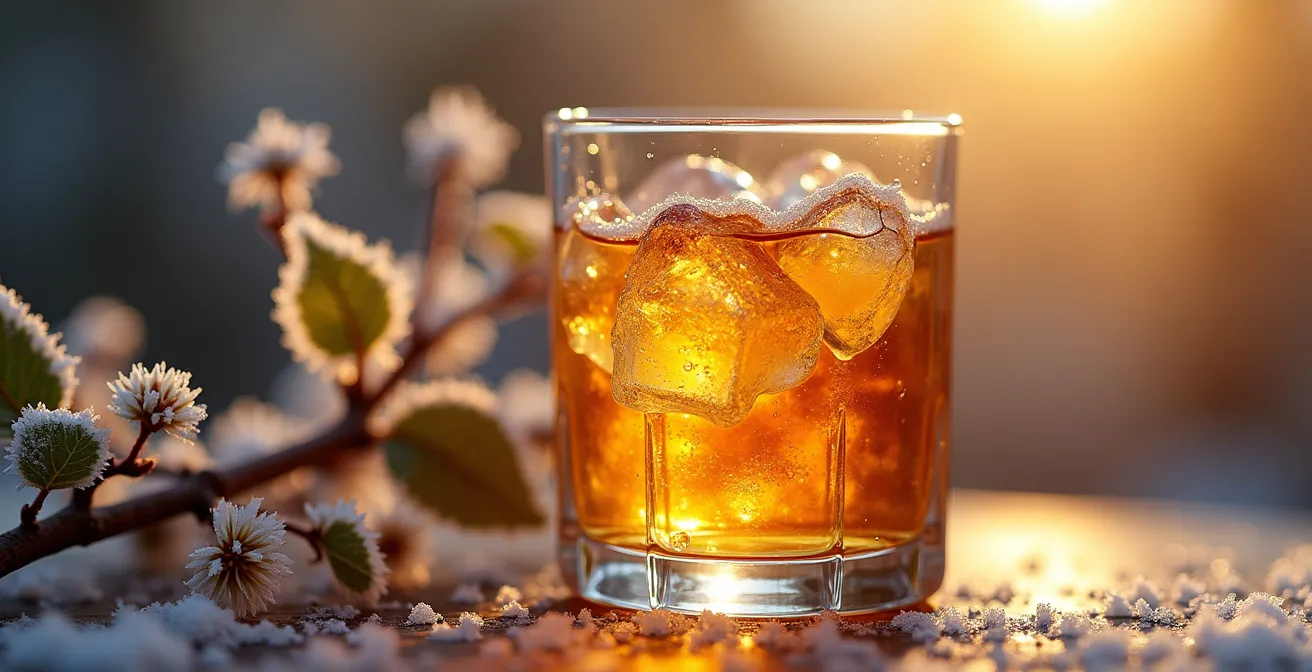
This nectar is the result of a natural concentration of sugars by cold, a technique that imparts exceptional aromatic richness. A successful tasting allows you to break down this complexity. Instead of just drinking, think about “analyzing” the product. The following process will guide you from a simple tasting to a true exercise in organoleptic discernment.
- Serve at the right temperature: The key is to serve it cool, but not ice-cold. A temperature between 6 and 8°C is ideal so that the aromas are not numbed by the cold.
- The first nose (before swirling): Bring the glass to your nose and inhale gently. Look for primary aromas, often dominated by apple in all its forms: cooked apple, compote, Tatin tart, or even caramel.
- Swirling and the second nose: Gently swirl the cider in your glass. This simple gesture oxygenates the liquid and releases more subtle, “secondary” aromas. Smell again and try to identify notes of honey, dried apricot, tropical fruits, or even sweet spices.
- The attack on the palate: Take a small sip. The first sensation should be one of perfect balance. A great ice cider is not just sweet; it possesses a vibrant and refreshing acidity that balances the richness of the sugar. This is the signature of a well-mastered northern terroir.
- The finish: After swallowing, focus on the persistence of the aromas. A long finish, where flavors of candied fruits and a hint of minerality persist, is the hallmark of the best products.
Island vs. supermarket strawberries: is the taste difference worth the trip?
The question may seem trivial, but it’s at the heart of the quest for authenticity. Comparing a strawberry from Île d’Orléans, picked that very morning, to its supermarket cousin is a confrontation of two philosophies. The commercial strawberry is selected for its durability, uniform size, and resistance to transport. Taste, while present, is often secondary. Conversely, a local producer’s strawberry is chosen for its aromatic concentration. Picked at full maturity, it hasn’t had to endure days of transport and refrigeration that degrade its sugars and most volatile fragrances.
Île d’Orléans, which Jacques Cartier named “Isle of Bacchus” in 1535 due to the abundance of wild vines, possesses an exceptional terroir and microclimate. This historical and geographical richness can be tasted. A strawberry from the island, still warm from the sun, offers an explosion in the mouth: a firmer texture, a more complex sweetness, and a hint of acidity that makes it incredibly lively. The difference isn’t measured; it’s felt. The scent that emanates from it even before biting is an unmistakable clue.
So, is the trip worth it? For the epicurean, the answer is a resounding yes. It’s not just the purchase of a fruit, but the experience of superior organoleptic quality. It’s understanding through taste why terroir matters. It’s an opportunity to chat with the producer who might explain that they grow a variety that is less productive but infinitely more flavorful. Making this detour means choosing taste over convenience, a decision that defines the true terroir enthusiast.
The error of improperly storing fine cheeses that makes them mold in 3 days
You’ve found a gem: an artisanal bloomy rind cheese, as creamy as can be. Back home, by reflex, you wrap it in plastic film and put it in the fridge. Three days later, it’s damp, smells of ammonia, and is starting to mold. This is the most common and fatal mistake. Plastic film suffocates the cheese, which is a living product. It blocks the evaporation of moisture, creating an ideal environment for bad bacteria.
Proper preservation is an art that respects the nature of the cheese. Each type of paste requires particular attention to continue its ripening and preserve its flavors. The secret lies in controlling two factors: humidity and respiration. Good packaging must allow the cheese to breathe while preventing it from drying out. Forget plastic and adopt the techniques used by professionals.
Here is a practical guide to never wasting your cheese treasures again, including during transport on your tour:
- Soft cheese with bloomy rind (e.g., Riopelle de l’Isle): Wax paper or parchment paper is your best ally. It allows gas exchange while protecting the cheese. Place it in the vegetable drawer of your refrigerator, where the temperature is most stable (4-8°C).
- Soft cheese with washed rind (e.g., 1608 from Charlevoix): These characterful cheeses need humidity. Store them in their original packaging or perforated paper, in a slightly ajar container to maintain high humidity (85-90%).
- Firm cheese (e.g., Alfred Le Fermier): They are less fragile. Aluminum foil or perforated plastic wrap is suitable, at a slightly higher temperature (6-10°C).
- Blue cheese (e.g., Bleu Bénédictin): Wrap them in aluminum foil without tightening too much, to prevent the blue mold from contaminating other cheeses.
- Transporting during a tour: A cooler is essential. Use ice packs rather than direct ice, which could get the packaging wet. Ensure slight air circulation to avoid condensation.
When to buy your maple syrup supplies: the moment when the price is lowest
Maple syrup is the emblem of Quebec, but its price can vary considerably. The classic tourist mistake is buying it during the height of the sugar season or in a souvenir shop, where prices are inflated by demand and marketing. The savvy consumer knows that the best time to stock up is against the grain. It is in the late spring, in May or June, that opportunities arise.
At this time, small maple producers often look to clear their surplus production before the summer season. They then offer significant discounts, particularly on large formats like cans and gallons. This is the ideal time to buy a high-quality product in quantity at an unbeatable price. This post-season buying strategy allows you not only to save money but also to directly support a producer who values their inventory. Some, as with the example of the fortified wine Le Portageur, even innovate to transform this surplus into value-added products.
The following table clearly illustrates where the best deals are, helping you plan your purchase strategically.
| Sales Point | Average Price/Liter | Advantages | Best Time to Buy |
|---|---|---|---|
| Direct Producer | $12-15 | Superior quality, direct contact | May-June (for surpluses) |
| Grocery Store | $18-22 | Constant availability | Seasonal promotions |
| Tourist Market | $20-28 | Gift packaging | Avoid to save money |
In short, when it comes to maple syrup, patience pays off. Planning your purchase outside the frenzy of the sugar season is the secret to combining artisanal quality with a controlled budget.
How to spot real terroir products without relying solely on labels?
Labels like PGI are excellent indicators, but they don’t tell the whole story. The authenticity of a terroir product often lies in intangible details that only human contact can reveal. This is what I call the economy of trust. To cultivate it, one must learn to look beyond the label and ask the right questions. Attractive packaging can hide an industrial product, while a sober bottle can contain an exceptional nectar.
A true artisan is intimately linked to their product. They know every facet of it, from the exact plot of land where their fruits come from to the weather on the day of harvest. This is the tangible traceability you should seek. Engage in conversation. A passionate producer will always be delighted to share their story and expertise. Their pride is not in marketing, but in the quality of what they have created with their own hands.
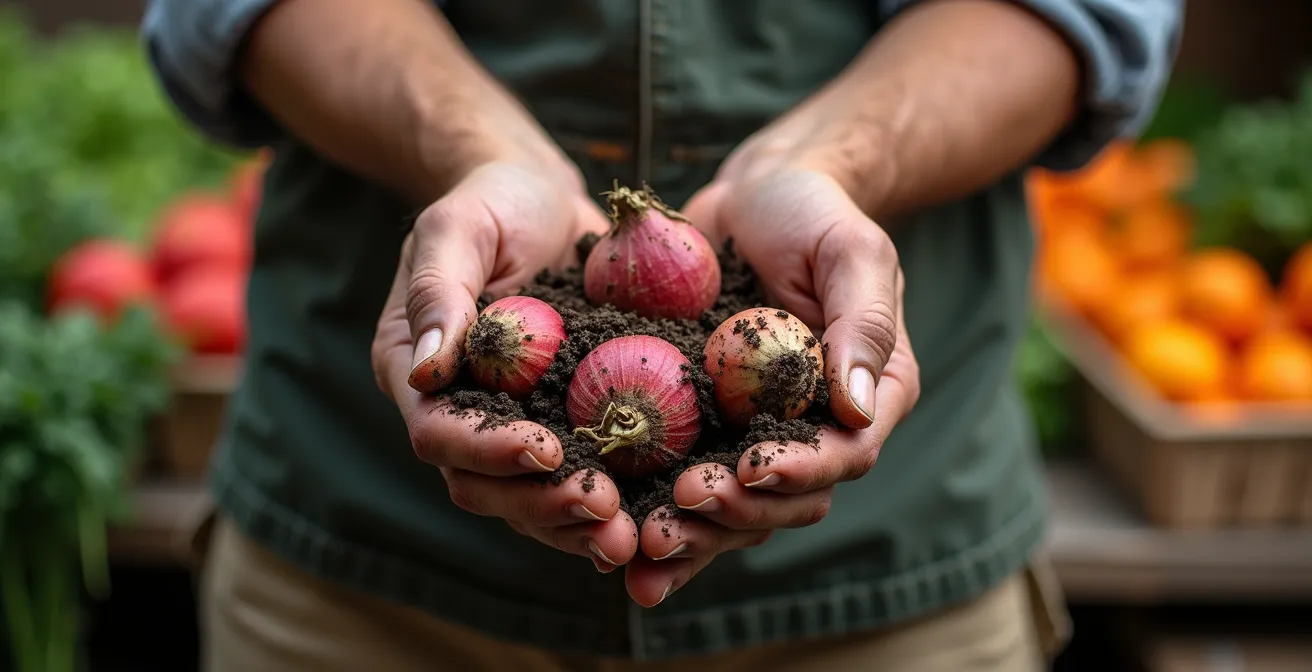
To guide you, I have developed a simple method, the “5Ps method,” which acts as a checklist to quickly evaluate the degree of authenticity of a product and its creator.
Your Action Plan: The 5Ps Method for Judging Authenticity
- Producer: Are they present, passionate, and able to tell the story of their product? A true artisan is their own best ambassador.
- Provenance: Ask about the plot of land, the exact variety. An authentic producer knows every corner of their farm and will answer you precisely.
- Process: Is the manufacturing process visible or explained in detail? Transparency about methods is a mark of trust.
- Packaging: Beware of overly flashy packaging. Prioritize humble and informative labels that focus on the product, not the container.
- Price: Is the price fair and justifiable? A high price can be explained by a small production, intensive manual labor, or long aging. Ask why.
Finally, don’t hesitate to ask a test question: “Can I find this product in my grocery store in Montreal?”. The pride in an artisan’s “no” is often the best label there is.
When to sign up for farm baskets: the timing to get the best farms
Subscribing to a farm basket is an excellent way to ensure a steady supply of fresh, local products. However, the most reputable farms—those that practice diversified and careful organic agriculture—are highly sought after. Waiting until spring to sign up is often too late. The secret, as with syrup, is anticipation. Registrations for the summer season open as early as January or February.
This is when farmers plan their production and need firm commitments to finance their seeds and the start of the season. To maximize your chances, a proactive strategy is recommended. Take advantage of the previous autumn to visit the farm stands of producers you are interested in. It’s a sort of “audition”: you taste their products, discuss their agricultural philosophy, and establish an initial contact. This personal relationship can make all the difference when registration time comes.
This direct link strengthens the vitality of the agricultural sector, a dynamic sector that sees, for example, a 30% increase in the quantity of grapes harvested. Additionally, some regions concentrate exceptional producers. Knowing that the Brome-Missisquoi Wine Route alone represents 60% of Quebec’s wine production is a clue to the concentration of expertise in certain terroirs. Signing up early for a basket from a farm in these regions means securing a front-row seat to agricultural excellence.
Key Takeaways
- The PGI “Quebec Wine” designation is more than a logo; it is your best guarantee of traceability and quality compared to generic products.
- The authenticity of a terroir product is measured less by its label than by the passion and transparency of the producer. Use the 5Ps method to judge.
- Timing is crucial: buy your maple syrup in May-June for the best prices and sign up for farm baskets starting in January to access the best farms.
Why prioritizing local buying in Quebec is your best shield against shortages?
Buying local is often presented as a civic gesture for the economy. This is true, but its most tangible and personal benefit lies elsewhere: it constitutes your best insurance for your food security. The COVID-19 pandemic was a brutal demonstration of this. While grocery store vegetable shelves went empty, victims of the fragility of long global supply chains, short circuits proved remarkably resilient.
Those who had already forged links with local producers, via organic baskets or regular farm visits, continued to receive fresh, high-quality food without interruption. This is no coincidence. A short circuit is naturally more agile and less dependent on the hazards of international transport, border closures, or logistical crises. By prioritizing direct buying, you aren’t just supporting a farmer; you are investing in a robust and reliable supply system that protects you from external shocks.
Strengthening your local food security isn’t complicated, but it requires a change in habits. It involves moving from being a passive consumer to becoming an active partner in the local food system. Here are some concrete strategies to build your own shield:
- Diversify your sources: Don’t depend on a single supplier. Subscribe to a vegetable basket, buy your meat from a breeder, and your cheese from an artisanal creamery.
- Invest in the relationship: Visit farms, understand their challenges, become a loyal and known customer. This relationship of trust is invaluable in times of crisis.
- Accept seasonality: Learn to cook with available products. It is a creative constraint that reconnects you to the rhythm of nature.
- Preserve and store: Master simple techniques like freezing, canning, or lacto-fermentation to enjoy abundant harvests all year round.
- Calculate the true cost: The price of local food includes its freshness, nutritional quality, and, above all, the resilience of its supply. It is an investment, not an expense.
Your next gourmet getaway begins not on a road map, but with a conversation with a producer. By applying these principles, you will no longer be a mere tourist, but an enlightened explorer of the Quebec terroir. Set off on your discovery with an open palate and mind.
Frequently Asked Questions on Quebec Cheesery Tours
Where can I find special cheese wrapping paper in Quebec?
Artisanal cheeseries and specialty boutiques like those found on the Wine Route or in public markets (e.g., Jean-Talon Market) offer this special paper. It is designed to allow the cheese to breathe while maintaining ideal humidity, which is impossible with plastic film.
How long can fine cheeses be transported by car during a tour?
With a quality cooler and ice packs (not loose ice that melts), your cheeses can be transported safely for up to 6-8 hours. The trick is to ensure the car isn’t in direct sunlight and to leave a slight air circulation in the cooler to prevent condensation.
Can Quebec artisanal cheeses be frozen?
Freezing is strongly discouraged for soft cheeses (bloomy or washed rind), as the thawing process breaks their structure and makes them runny and grainy. Firm cheeses can technically be frozen, but they will lose some of their aromatic complexity and their texture will become more crumbly. Keep as a last resort.