Safety when encountering a bear or a moose does not depend on the animal, but on our ability to read its language and anticipate the invisible impact of our presence.
- Real danger arises from ignorance of the animal’s tolerance thresholds, which our actions, even well-intentioned, can cross.
- Feeding an animal, even indirectly with fruit scraps, is a form of condemnation that alters its natural behavior and puts it in danger.
- Proper optical equipment is not a gadget, but a fundamental tool of respect that allows for maintaining a safe and ethical distance.
Recommendation: Adopt a “proactive safety” approach: plan every detail (location, time, equipment, waste management) before even leaving to transform potential risk into a respectful and memorable experience.
The image is striking: the breath of a moose in the cold morning air, the massive silhouette of a black bear at a bend in the trail. For any photographer or nature lover in Quebec, these encounters are a life goal, moments of pure connection with the wild. The temptation to move closer, to capture the perfect shot, is immense. We all know the basic advice: “keep your distance,” “don’t feed the animals.” These rules, while correct, are only the tip of the iceberg.
What if the real danger didn’t come from the bear’s claw, but from our own ignorance of its sensory world? What if our simple presence, our scents, our most harmless gestures were actually invisible aggressions that trigger the reactions we dread so much? The key to safe observation lies not only in what to avoid doing, but in what needs to be understood. It is about trading our human perspective for that of the animal, reading its signals, and respecting its world.
This article is not just a list of prohibitions. It is an immersion into the psychology of Canadian wildlife. As a biologist, I propose to dissect the body language of a stressed moose, understand why a banana peel is an ecological time bomb, and how the choice of your binoculars is in itself an act of respect. We will learn to become ghost observers—present but unnoticed—so that every encounter remains what it should be: magic, not a threat.
To navigate through this fascinating approach to wilderness safety, this article is structured to guide you step-by-step, from animal psychology to practical choices in the field. Here are the points we will explore together.
Summary: Secrets of Safe and Ethical Wildlife Observation in Quebec
- Why is approaching a mother moose more dangerous than crossing paths with a wolf?
- Binoculars or spotting scope: which optics to choose to see whales from the shore?
- Wildlife Reserve or National Park: where do you have the best chance of seeing a bear?
- The mistake of feeding a fox for a photo that condemns it to death
- Dawn or dusk: what time to prioritize for seeing active wildlife?
- Why leaving fruit waste in the woods is worse than you think?
- Why is Old Quebec fortified and what did that change for the inhabitants?
- Wild Camping or Glamping: which experience to choose for a first contact with nature?
Why is approaching a mother moose more dangerous than crossing paths with a wolf?
In the collective imagination, the wolf is the ultimate predator. Yet, in Quebec, dangerous wildlife encounters much more often involve an animal we perceive as a gentle herbivorous giant: the moose. The danger does not come from malice, but from an instinct we systematically underestimate: the maternal instinct. A female moose (the cow) with her calf has an extremely low tolerance threshold. Approaching within 50 meters is perceived not as curiosity, but as a deadly threat to her offspring.
Unlike the wolf, which will avoid humans 99% of the time, the mother moose will choose confrontation. Her sole objective is to neutralize the threat. Before charging, she sends a series of clear signals that every observer must know how to decode. Learning this behavioral reading is the first line of defense, far more effective than any pepper spray. It is a silent dialogue where the animal tells you “stop.”
Signs of agitation that should never be ignored include:
- Ears pinned back: This is the first sign of intense stress. The animal is no longer curious; it is on the defensive.
- Raised hackles (hair) on the withers: Like a cat, the moose tries to appear more imposing. This is a final warning before escalation.
- Jerky head movements and teeth clicking: The animal is agitated and expressing its discomfort visibly.
- Scraping the ground with its hooves: This is the ultimate warning before a charge. If you see this behavior, you are already far too close.
Observation, particularly during the rutting period in September, when animals are more visible, must be done with absolute respect for these signals. The danger of the moose is not its nature, but our inability to understand its language.
Binoculars or spotting scope: which optics to choose to see whales from the shore?
Distance observation is not a constraint; it is a philosophy. It is the materialization of respect. Choosing the right optical equipment is therefore an act of proactive safety. Whether it’s admiring the blow of a rorqual from the Tadoussac coast or distinguishing the velvety antlers of a white-tailed deer, the tool you hold in your hands defines the distance you grant the animal. Powerful binoculars or a spotting scope aren’t for “seeing better,” but for “seeing well, from afar.”
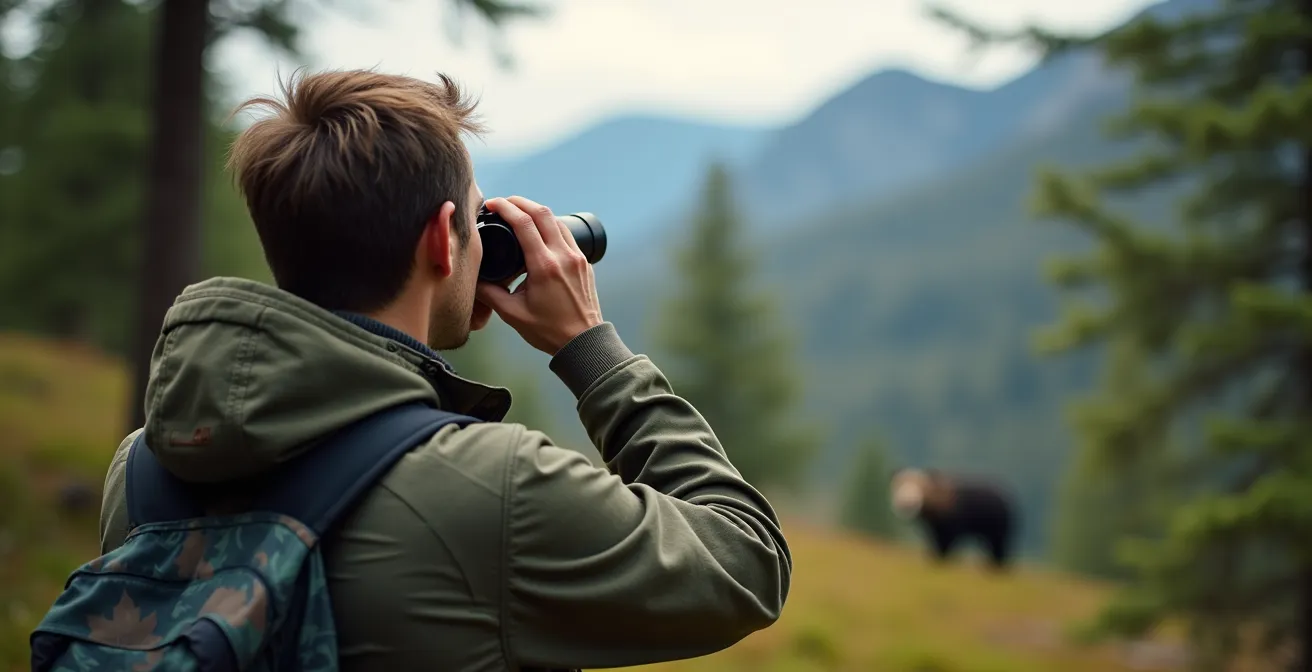
The choice between binoculars and a spotting scope depends mainly on three factors: the distance of the animal, your mobility, and light conditions. Binoculars, which are lighter and offer a wider field of view, are ideal for the forest and moving animals. The spotting scope, requiring a tripod, is king for static observations at very long distances, such as marine mammals or a caribou on the tundra.
This comparative table, based on an analysis of equipment for Canadian wildlife, will help you make an informed choice.
| Criterion | 8×42 Binoculars | 10×42 Binoculars | 20-60×80 Spotting Scope |
|---|---|---|---|
| Optimal observation distance | 50-200m | 100-400m | 300-1000m+ |
| Average weight | 700g | 750g | 1500-2000g |
| Field of view | Wide (130m at 1000m) | Medium (110m at 1000m) | Narrow (30m at 1000m) |
| Rugged terrain use | Excellent | Good | Requires tripod |
| Twilight observation | Very good | Good | Excellent |
| Average price (fair quality) | $400-800 | $450-900 | $1000-2500 |
| Ideal for in Canada | Forest/Close moose | Mountains/Bears | Plains/Distant caribou |
Wildlife Reserve or National Park: where do you have the best chance of seeing a bear?
Seeing a black bear is often the holy grail for Quebec explorers. But where should you look? The answer doesn’t depend on luck, but on an understanding of ecosystems and the mandates of each territory. Quebec’s National Parks (Sépaq) have a primary mission of conserving natural environments. Wildlife there is totally protected, and animals, being less fearful, are often easier to observe from roads and marked trails. Places like Jacques-Cartier Park or Mauricie National Park are must-visits.
Wildlife Reserves, on the other hand, have a dual mission of conservation and wildlife development, which includes regulated hunting and fishing activities. Animals there may be more wary. However, their vast territories, such as the Laurentides Wildlife Reserve, house high densities of animals. Some specialized outfitters in these zones even guarantee sightings, with a black bear sighting success rate exceeding 75% under controlled and safe conditions.
The choice therefore depends not only on the location but also on the season and time of day. A bear is not in the same place in May, when searching for young shoots in valleys, as in August, when gorging on blueberries on mountain slopes. “Proactive safety” begins with this strategic planning.
Action Plan: Your Checklist to Maximize Observation Chances
- Identify the season: Is your outing in the spring (valleys), summer (berry zones), or autumn (oak/beech forests)? Adapt your destination.
- Choose the golden hours: Plan your excursions mainly early in the morning (5am-8am) or late in the day (5pm-8pm), when wildlife is most active.
- Consult local experts: Before every outing in a park, stop by the visitor center and ask park rangers or biologists where wildlife has been spotted recently. They are your best source of information.
- Study the map: Identify water sources, forest edges, and potential feeding areas. These are wildlife magnets.
- Validate the type of territory: National Park for more accessible observation from infrastructure, or Wildlife Reserve (potentially with a guide) for deeper immersion.
The mistake of feeding a fox for a photo that condemns it to death
It is a scene that is unfortunately too common: a curious fox approaches a picnic area, and someone, thinking they are doing a good deed, hands it a piece of their sandwich to get the perfect photo. This act, which seems harmless and generous, is actually a sentence. This is what we call condemnation by habituation. By associating humans with an easy food source, the animal gradually loses its natural fear and its ability to hunt and survive on its own.
A habituated fox or bear becomes a “problem animal.” It will approach roads, campsites, and houses, creating dangerous situations that often end in its capture and euthanasia. Your gesture didn’t “help” it; it killed it slowly. Authorities do not take this subject lightly. In Canada’s national parks, feeding wildlife can lead to a fine of up to $25,000. This staggering sum is not there to punish, but to highlight the gravity of the consequences of this action.
Parks Canada summarizes it perfectly in its safety guides:
Wild animals have learned to find the food they need in their natural environment… They do not need your help. Feeding animals, even indirectly by leaving food or garbage, teaches them that humans can provide food.
– Parks Canada, Safety Guide – Riding Mountain National Park
The only true help you can provide is not to intervene, keep your food to yourself, and manage your waste impeccably. The most beautiful gift you can give a wild animal is to let it stay wild.
Dawn or dusk: what time to prioritize for seeing active wildlife?
The forest often seems silent and empty in the middle of the afternoon. This is not an illusion. Most large mammals, such as black bears, moose, or white-tailed deer, are crepuscular creatures. Their peak activity is concentrated in two precise time windows: dawn and dusk. Understanding the “why” of this rhythm is essential for planning a fruitful and respectful outing.
This behavior is dictated by several factors. First, heat. Massive animals like moose, with their thick fur, suffer terribly from summer heat. They prioritize the cool hours of the morning and evening to move and feed. Second, the escape from insects. During hot days, swarms of black flies and mosquitoes are a real plague. Seeking refuge in water or the heart of the dense forest is a survival strategy. Finally, dawn and dusk offer lower light levels that allow them to feel less exposed to predators while giving them an advantage over their prey.

For the observer, this means success is often found at the ends of the day. Waking up at dawn or being patient until sunset is not a constraint, but a strategy for aligning with the natural rhythm of the forest. It is during these magical hours, when the light is soft and golden, that the forest awakens and offers its most beautiful encounters. Bears, which hibernate from October to April, are particularly active during these times for the rest of the year to accumulate necessary reserves.
Why leaving fruit waste in the woods is worse than you think?
“It’s biodegradable, animals will eat it.” This sentence, spoken while throwing a apple core or a banana peel into the forest, starts with good intentions but is based on a profound misunderstanding of Canadian ecosystems. Organic waste is not a gift for nature; it is a sensory intrusion and a time bomb for wildlife. In Quebec’s cool climate, an orange peel can take up to two years to decompose. During all that time, it emits powerful and unusual odors.
For a black bear, whose sense of smell is seven times more powerful than that of a bloodhound, that apple core is an olfactory beacon. By following this scent, it is drawn toward trails, campsites, and human zones. This is the first step toward the “condemnation by habituation” mentioned earlier. It learns that humans mean easy food. With a population of about 70,000 black bears living in Quebec’s forests, multiplying these “small” pieces of waste creates a large-scale problem, drastically increasing the risks of conflict-prone encounters.
The “Leave No Trace” principle is therefore absolute and non-negotiable. It is not just about taking back plastic packaging, but ALL waste.
- Pack it all out: This includes peels, pits, cores, and even dishwater containing food particles.
- Use airtight bags: A “Ziploc” type bag or a dedicated dry bag helps contain odors and prevents attracting wildlife to your backpack.
- Never bury: Animals have a sense of smell powerful enough to dig up any food waste. Burying only hides the problem; it doesn’t solve it.
- Inspect your site: Before leaving a picnic area or campsite, do a meticulous inspection to ensure that not a single bit of waste remains.
Why is Old Quebec fortified and what did that change for the inhabitants?
At first glance, the ramparts of Old Quebec, vestiges of military history, seem to have no connection with observing a moose in Gaspé. And yet, they teach us a fundamental lesson about barriers and fragmentation. These walls were erected to separate, control passages, and protect a territory. Today, our modern “fortifications” are no longer stone, but asphalt. The highways that crisscross Canada are almost impassable barriers for wildlife.
These roads fragment habitats, isolate animal populations, and cause tens of thousands of collisions every year. They create ecological “islands” where animals are trapped, limiting their access to food, reproductive partners, and new territories. This fragmentation is a silent threat, as dangerous to species survival as poaching. Observing an animal on the side of a highway is not a sign of a healthy ecosystem, but often a symptom of its desperation.
Faced with this reality, innovative solutions are emerging, seeking to “break” these modern fortifications. Banff National Park in Alberta is a global pioneer in this field. More than 40 crossing structures (vegetated bridges and tunnels) have been built to allow wildlife to cross the Trans-Canada Highway safely. The results are spectacular: an 80% reduction in collisions and more than 150,000 safe crossings per year. This approach shows that it is possible to reconcile human development and ecological connectivity. It is an inspiration for the future of conservation in Quebec and elsewhere.
Key Takeaways
- The greatest danger in the forest comes from human ignorance of animal language (crossing the tolerance threshold), not from the innate aggressiveness of wildlife.
- Feeding an animal, even indirectly through organic waste, condemns it by creating a dangerous habituation that often leads to its euthanasia.
- Ethical observation is based on “proactive safety”: choosing the right place, time, and equipment (optics) to remain at a respectful distance.
Wild Camping or Glamping: which experience to choose for a first contact with nature?
After assimilating the principles of ethical observation, the choice of accommodation for a night in nature becomes a crucial strategic decision. It is no longer just a question of comfort, but the final stage of your “proactive safety” planning. Wild camping, glamping (or oTENTik ready-to-camp), or serviced camping in a national park: each option defines a different level of responsibility and exposure to risk, especially for a beginner.
Wild camping offers maximum immersion but also total responsibility. You are alone with nature. Managing food and waste becomes a survival issue, involving techniques like hanging food or using bear-resistant containers. It is an intense experience, reserved for those who already master the basics.
At the opposite end, glamping or Parks Canada’s oTENTik tents offer a cocoon of safety. A rigid structure, centralized waste management, and the proximity of park staff reduce stress to a minimum. It is an ideal gateway for a first contact, allowing you to focus on observation without the anxiety of safety logistics. Serviced camping represents an excellent compromise, offering an authentic tent experience while benefiting from secure infrastructure like bear lockers.
This table will help you position your choice based on your experience level and desired immersion.
| Criterion | Wild Camping | Glamping/oTENTik | Serviced Camping (National Park) |
|---|---|---|---|
| Physical protection | Standard tent | Rigid structure | Tent + infrastructure |
| Waste management | Autonomous (hanging) | Centralized | Bear lockers |
| Distance from wildlife | Very close (risky) | Moderate | Designated areas |
| Immersive experience | Maximum | Limited | Balanced |
| Beginner stress level | High | Low | Moderate |
| Emergency support | None | Staff on site | Regular patrols |
| Approximate cost/night | $20-30 | $100-200 | $30-50 |
Your next encounter with Quebec’s wild fauna begins now, not in the forest, but in meticulous and respectful planning. Gear up, inform yourself, and become the observer that nature deserves.
Frequently Asked Questions about Wildlife Observation in Quebec
What is the safety triangle rule in wild camping?
The tent, the cooking area, and the food storage area must be separated by at least 100 meters from each other, forming a triangle. This prevents food smells from attracting animals toward your sleeping area.
Are bear containers really necessary?
Absolutely. They are mandatory in several Canadian national parks. A bear can smell food from several kilometers away and easily destroy a cooler or a tent to access it.
Is glamping less authentic for observing wildlife?
Not necessarily. Glamping structures are often located in excellent observation sites and allow beginners to get started safely before attempting wild camping.